






WeChat ID :


Login/Register

 Posted on 21 Jun 2026
 12017








We are living in an era when getting rich feels impossible,
with petrol costing 50 baht per litre.
Every time we leave home,
we may have to calculate and think much more carefully.
I was thinking about it,
so I decided to break down the expenses in detail
and see what leaving home really costs us.
The cost of being a real-estate agent
“How much real money does one property viewing cost?”
Many people think real-estate agents have an easy job.
The truth is that before receiving even one baht of commission,
the agent invests money from their own pocket.
Every time an agent accepts a client appointment,
there are visible and invisible costs.
No one guarantees those costs
and no one reimburses them
if the deal does not close.
Part 1: Five main categories of expense
When estimating the real expense
of one property viewing:
For people who want to read less:
An agent must carry these costs
before receiving commission:
1. Travel: fuel, tolls and parking.
Estimated at 150–500 baht.
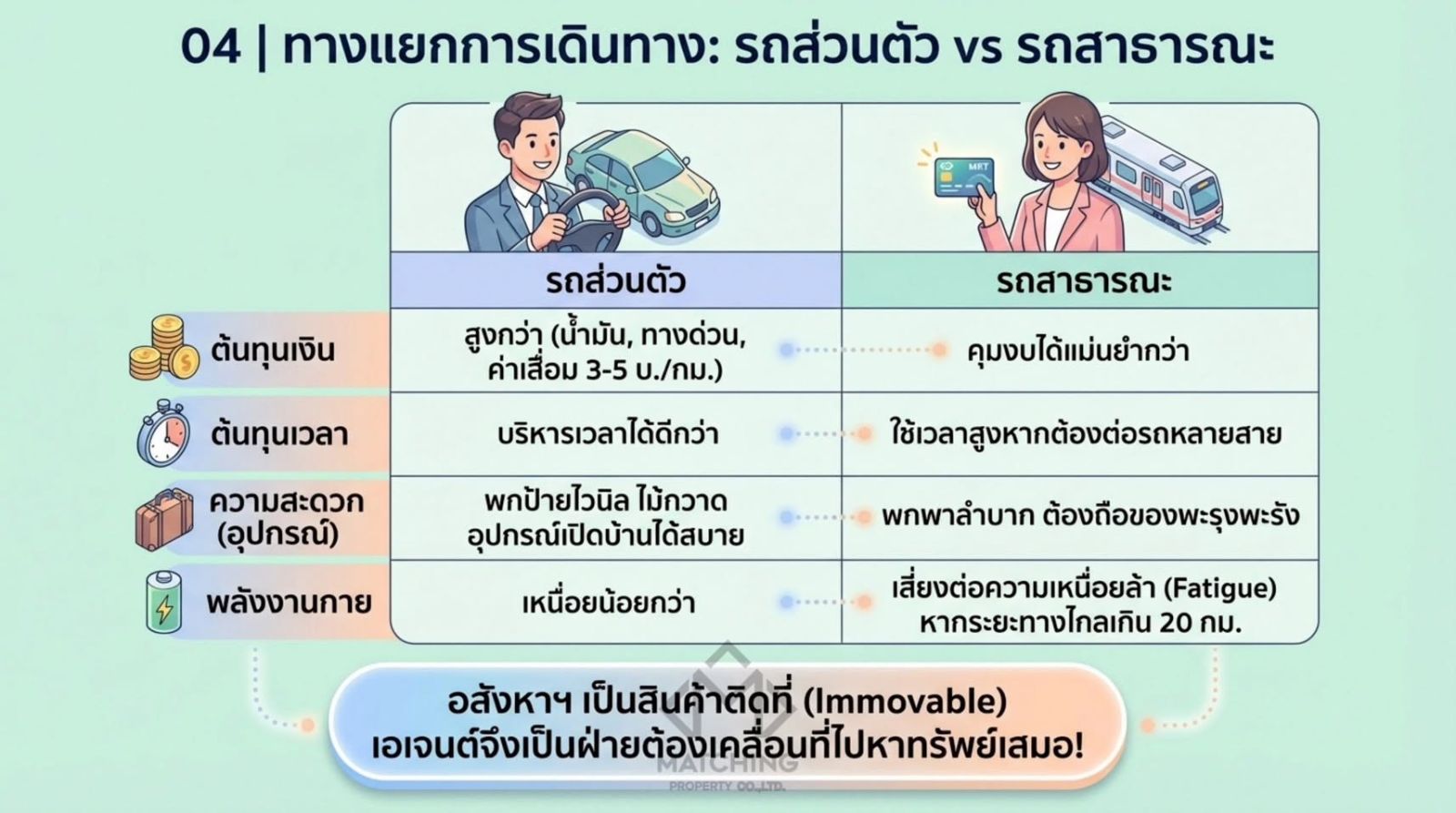
2. Vehicle depreciation: wear on the car, averaging 3–5 baht per kilometre,
such as tyres, brakes and engine oil.
Estimated at 100–300 baht.
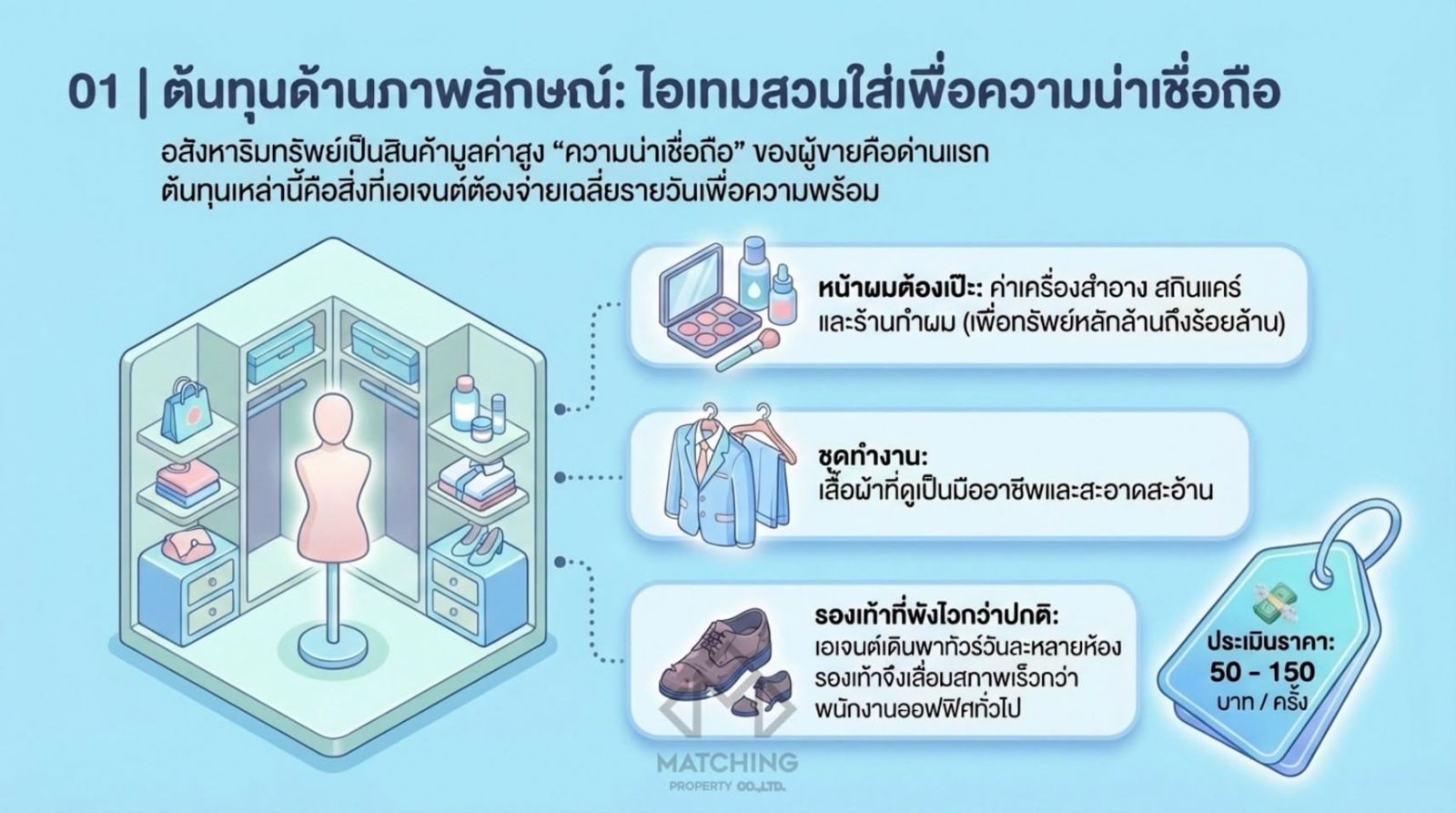
3. Appearance: make-up, hair, clothing and shoes.
Estimated at 50–150 baht per appointment.
4. Client hospitality: coffee, drinking water and discussing work at a café.
Estimated at 150–400 baht.
5. Documents and other items: printing, viewing equipment, vinyl signs and miscellaneous costs.
Estimated at 20–100 baht.
Total expenses
come to approximately 470–1,450 baht.
End of the short-reading section
.
.
.
Part 2: Travel cost by distance
Real estate is an “immovable” product.
The agent therefore always has to travel to the property.
This cost changes directly
with the round-trip distance.
The average figures may differ according to traffic,
fuel consumption
and the transport network in each area.
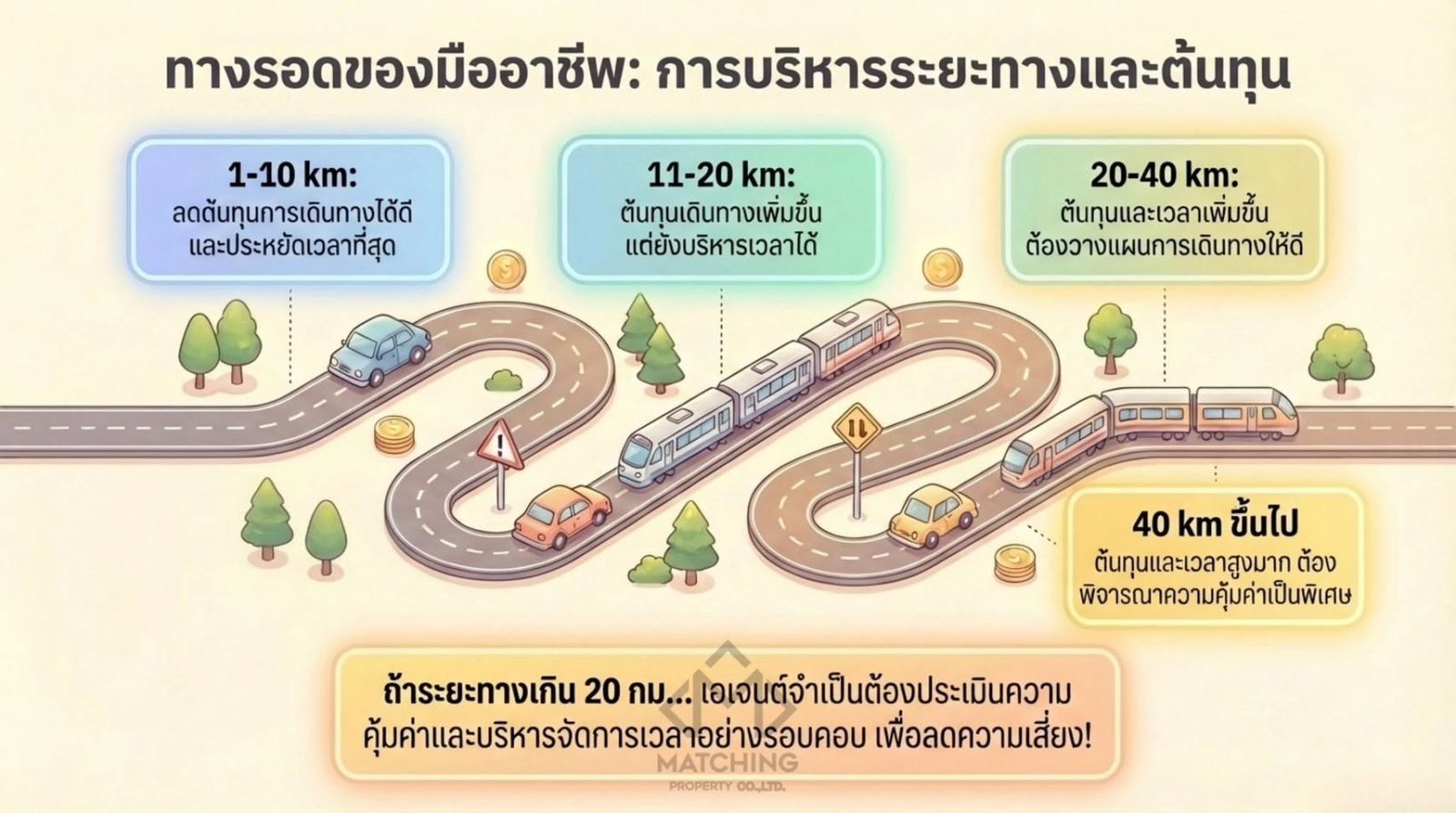
Round-trip distance: 1–10 km (very close)
Private car: 100–200 baht.
Public transport: 80–150 baht.
Key factors:
Private car: a little fuel and parking.
Public transport: BTS/MRT fare and a motorcycle taxi into the soi.
Round-trip distance: 11–20 km (close)
Private car: 200–400 baht.
Public transport: 150–300 baht.
Key factors:
Private car: fuel, possibly tolls and depreciation.
Public transport: the full rail journey and a taxi at the destination.
Round-trip distance: 20–40 km (medium)
Private car: 400–700 baht.
Public transport: 300–600 baht.
Key factors:
Private car: more fuel, round-trip tolls and depreciation.
Public transport: several connections or a long taxi ride.
Round-trip distance: over 40 km (cross-province or suburban)
Private car: 700–1,500+ baht.
Public transport: 600–1,200+ baht.
Key factors:
Private car: a full fuel cost, expressway fees and high depreciation.
Public transport: a long-distance taxi, a chartered vehicle or even a chartered flight.
Comparing travel options: private car versus public transport
Using a private car makes time management easier.
You can pick up and drop off customers,
carry viewing equipment
and arrive early to prepare the room.
The disadvantage is a higher cash cost,
hidden depreciation
and parking that can consume a significant part of the budget.
Public transport makes the budget easier to control precisely
and is very suitable for condominiums near rail lines within 1–20 km.
The disadvantage is that travelling to a suburban detached house is difficult,
the time cost rises sharply
and several connections may leave you tired before meeting the customer.
.
.
.
Part 3: Time cost—the most expensive cost that cannot be seen
Time is the only cost that, once paid, can never be recovered.
It is also the cost most often overlooked.
One property viewing takes more time than people think:
Preparation and travel to the property: 1–1.5 hours.
Showing the property and negotiating: 1–2 hours.
Closing the property and travelling back: 1–1.5 hours.
The actual average time used is 3–5 hours
for one viewing.
That means an agent can fully serve
only two or three cases per day.
Calculating the value of your time as money
If your income target is 100,000 baht per month,
you work 20 days and 8 hours a day
(160 hours per month),
your time is worth 625 baht per hour.
One viewing that takes four hours
therefore means you have already paid 2,500 baht in time cost
(not including petrol and coffee).
If a customer says,
“I am just looking around; I am not planning to buy yet,”
the 2,500-baht time cost,
together with real expenses of 470–1,450 baht,
can become zero in a single appointment
with no one responsible for compensating you.
.
.
.
Part 4: Opportunity cost
Four hours spent with a customer
who is “not ready to buy yet”
is a lost opportunity.
You could have used those hours
to create income in other ways, such as:
Photographing and making videos for two or three new listings
and publishing them immediately.
Creating marketing content and running Facebook Ads to find new customers.
Following up and negotiating with customers whose loans have been approved
so they are ready to transfer ownership.
Building a farming-area network in the zone you know well
to receive new listings.
Studying promising new properties and comparing market prices
so you can advise customers more accurately.
.
.
.
Part 5: Prevention—pre-qualify the customer before starting the car
Professional agents who survive in this industry
value their time highly.
They screen customers thoroughly
before every appointment using these methods:
Purchase objective
Ask clearly: are they buying for themselves or investing?
When do they want to move in?
Do they have a clear timeframe?
Budget and purchasing power
What budget have they set?
Will they apply for a loan or pay cash?
Have they ever applied for a loan and been rejected?
Decision status
How many properties have they viewed?
Which places have they liked that are similar?
Who else is involved in the decision?
Use technology to help screen
Send a video tour or 360° images to view first.
If the customer likes the property,
then arrange a visit to the real thing.
Organise a clustered route
Schedule several customers in the same zone
or on the same day
to save both time and travel costs.
Finally, for a professional agent,
when the journey is over 20 km,
the cost per appointment can immediately reach 1,000–2,000 baht
(not including time).
That is why a good agent
must choose to accept work in a farming area
they know well
to reduce travel costs,
and must pre-qualify
customers thoroughly.
Because every time you give away your time for free
it is a real cost
that no one reimburses.
Note: All figures are average estimates.
They may differ according to traffic, routes
and the transport network in each area.
.
Join the conversation at
https://www.facebook.com/Ex.MatchingProperty/posts/pfbid0GmWNchXWcRzQ9d1ratu1kQndvS5GEadBpnJXjPyLfXtkpr9wTU3c6qDgJrpowm4Bl