






WeChat ID :


Login/Register

 Posted on 21 Jun 2026
 365026




How vast is the real estate universe? Let's take a look.
This is a business map that people outside the industry should know before entering it.
Whether you are an employee looking for a new opportunity, a new agent who wants to expand your career, or a first-time investor who does not yet know how many layers this industry contains, let this article be a short map for understanding every dimension of the real estate universe.
Many people think this business is only about selling houses and buying condominiums. In reality, real estate is a large ecosystem, more complex than most industries in the country.
It consists of three major worlds—three galaxies of knowledge—with clearly different paths and skills. If you are entering the industry, you need to know which galaxy you are in and what you must learn before moving to the next level.
Galaxy 1: The world of the agent—the starting point of the real estate industry.
Being an agent requires the least starting capital, but demands the most human skill. It combines psychology, sales, marketing, property knowledge, negotiation, and an understanding of people.
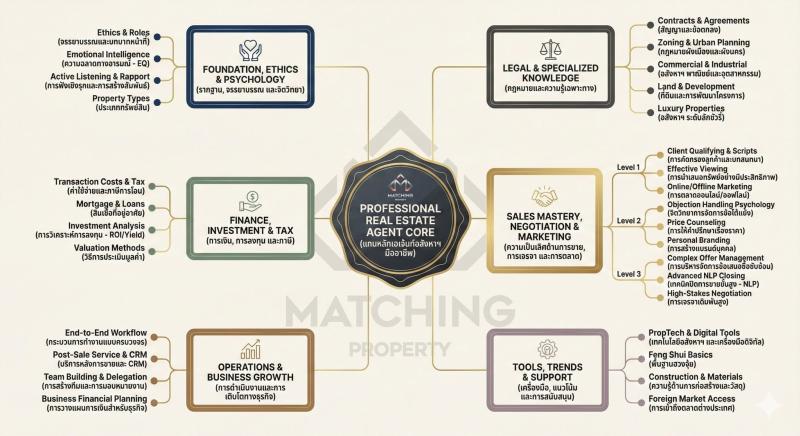
The Professional Real Estate Agent diagram shows six core areas agents must master:
1. Foundations, psychology, and the professional role: ethics, emotional intelligence, listening and relationship-building, and understanding property types.
2. Law and specialized knowledge: contracts, urban development and zoning; selling residential property; selling industrial and commercial property; and land and projects from economy to luxury.
3. Property finance and tax: transaction costs, taxes and expenses on transaction day, loans, and valuation methods.
4. Sales, marketing, and closing skills, from beginner to expert: qualifying clients, presenting property, online marketing, handling objections, managing offers, NLP closing, and high-stakes negotiation.
5. Digital tools and international trends: PropTech, basic feng shui, basic construction-material knowledge, and domestic and foreign markets.
6. Management and growing a business: workflow, after-sales service, building a team, and business planning.
Agent skills are the foundation of every path in real estate. Those who have worked as agents understand the market, buyers, sellers, and property types across the whole cycle before moving into another galaxy with more confidence.
Galaxy 2: The world of the investor—the territory of numbers, strategy, and precision.
Investors may be people who have begun to save money, have good bank credit, or are agents who have grown enough to accumulate their first capital. This world requires more money, and its risks rise with it.
The Professional Real Estate Investor diagram details seven areas investors need to know:
1. Thinking and reading the market like a professional investor: assessing risk, choosing active or passive investment, and analyzing economic cycles, interest rates, GDP, and consumers.
2. Analytical tools: calculating ROI, IRR, and NPV; analyzing cap rate, GRM, and OER; comparing markets through CMA; and checking documents and conducting due diligence.
3. Generating income from property: long-term rentals, Airbnb and short stays, dynamic pricing, accommodation SEO, and ways to grow the value of a property.
4. Commercial property investment: retail, offices, logistics, warehouses, self-storage, and e-commerce properties.
5. Active capital gains: flipping, staging, off-market hunting, zoning strategy, and strategic land holding.
6. Financing and leverage: LTV, DTI, DSCR, seller financing, subject-to arrangements, the BRRRR strategy, raising capital, and joint ventures.
7. Debt and paper investing: private lending, sale with redemption (Kai-Fak), non-performing loans, and distressed debt.
Galaxy 3: The world of the developer—the realm of people who build cities.
When you move from buying and selling existing assets to creating new ones, you enter the developer universe. It is the biggest, most complex, and riskiest world, but it can also offer the greatest returns and business influence.
The Developer Mastery diagram covers more than 60 topics across eight areas:
1. Market analysis and feasibility: location, land valuation, and feasibility studies using IRR and NPV.
2. Land acquisition and urban planning: land law, zoning, due diligence, and land-purchase strategy.
3. Finance and funding: capital structure, project financing, and investor relations.
4. Design and architecture: conceptual design, architecture, and obtaining construction permits.
5. Construction management: controlling costs, managing construction work, project scheduling, and quality control.
6. Marketing and sales: project marketing strategy, branding, and sales as a developer.
7. Legal matters and contracts: construction contracts, sale and purchase agreements, and property-development law.
8. Post-development and handover: handover procedures, resident care, warranties, and maintenance.
The heart of development is to run a feasibility study. Every project must pass the numbers test. If cash runs short, a project that was once a dream can become an unfinished concrete skeleton, as we repeatedly see in the news.
A career in real estate is a progression of knowledge. Starting as an agent teaches you about markets and buyer behavior. Becoming an investor teaches you numbers, risk, and sharper decision-making. Becoming a developer requires both of those disciplines together with management ability to build a dream project.
Real estate is not just one career. It is a universe full of distinct paths. The sooner you understand these three galaxies, the more clearly you can choose the path that suits you.
If you are about to enter the industry, learn the map before stepping onto the field. Real estate is not inherently risky; people who do not understand the system often create their own risk.
If you know which galaxy you are entering, prepare the right skills for each layer, and understand how to grow through each level, you will see opportunities most people miss and act with strategy. We will not do business by simply “giving it a try,” but by doing it with confidence.
Join the conversation at
https://www.facebook.com/Ex.MatchingProperty/posts/pfbid02qQmk1h5BZ2RHS782bLiwEwhGCF7TYU3KfsZ9tCiAUz2adn7Fv2gevQ9PVBgevEP8l