





WeChat ID :


Login/Register

 Posted on 21 Jun 2026
 65601
65601


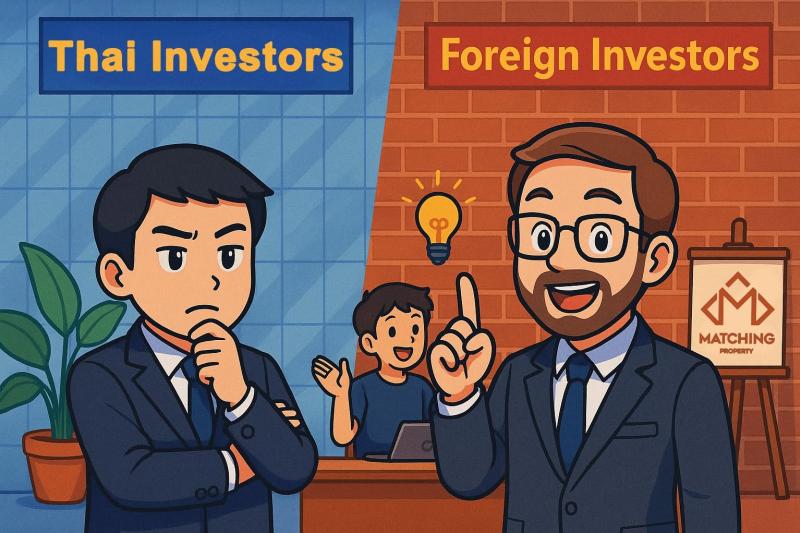
From my experience pitching investment opportunities
Thai and foreign start-up investors have noticeably different characteristics.
.
The difference is not simply about how much capital they have
or where the money comes from.
.
It is about how they view risk
how they assess vision
and how they understand the meaning of scale.
.
### Thai Investors: Cautious, Results-driven and Focused on Certainty
#### 1. They expect early profit and dislike heavy cash burn
Many Thai investors believe a business should become profitable
within its first year
or no later than the second year.
When a start-up continues to operate at a loss
it may be considered unprepared
or its model may be seen as unproven.
They therefore tend to prefer revenue-generating businesses
and remain cautious about models that must burn cash before growing.
.
#### 2. Connections can matter as much as risk appetite
“Who do you know?”
can influence an investment decision as much as the idea itself.
Founders with a strong background
credible introductions
or support from respected figures
often gain more opportunities than those without an established network.
.
#### 3. More conservative than visionary
Thai investors generally want a clear and measurable roadmap.
They prefer predictability
and do not welcome unnecessary surprises.
When a founder says
“We have no revenue yet, but we will disrupt the market”
the statement may not inspire confidence
unless it is supported by solid information and an executable plan.
.
#### 4. They examine the founder’s background closely
Product-Market Fit is not the only requirement.
Founder-Market Fit also matters
along with credibility
ethics
and a reliable professional history.
.
#### 5. They may invest without becoming deeply involved
Many Thai investors operate as passive investors.
They provide capital
but may offer limited mentorship.
When they become active investors
some may lean toward controlling the company
rather than supporting the founder.
.
### Foreign Investors: Willing to Take Risks When the Opportunity Can Go Far
#### 1. They consider scale before profit
Investors from Silicon Valley
Japan
Singapore
and many international markets
understand that certain business models
must accept early losses
to expand their customer base and establish a market.
The central question is not only today’s profit.
It is the company’s potential to dominate its market tomorrow.
.
#### 2. They place strong value on vision and team
When founders understand their market
demonstrate execution power
and present a sufficiently ambitious vision
foreign investors may provide initial funding
even before the company generates revenue.
They believe the right team
can be more important than early-stage numbers.
.
#### 3. They understand that failure is part of the game
Failing fast can be treated as a learning strategy
rather than a source of shame.
A founder who has previously failed
may still receive support
if they can demonstrate what they learned
and how that lesson has improved their decisions.
.
#### 4. They provide mentorship, networks and partnerships
Foreign investors often contribute more than capital.
They may provide access to international markets
co-investors
specialists
and strategic partners.
This creates value through an ecosystem
rather than focusing on ROI alone.
.
#### 5. They may use a more founder-friendly structure
Some foreign investors are willing
to let founders retain a significant ownership stake during the early stages.
They may avoid forcing excessive dilution in the first round.
Their term sheets can be structured to support growth
rather than prioritize control.
.
### The Right Investor Is Not Defined by Nationality Alone
Investor characteristics tell only part of the story.
We must also understand each investor’s area of expertise.
Some investors specialize in technology.
Others understand construction.
Some prefer businesses with fast investment cycles.
Others favor slower but more stable growth.
.
Even when our project does not fit an investor’s criteria today
we should preserve the connection.
No one knows what may happen in the future.
An investor we once pitched
may return when the timing is right.
They may also introduce us
to another investor whose interests match our project.
.
Capital can keep a business moving.
But an investor who understands the same game
can help the business travel much further.