






WeChat ID :


Login/Register

 Posted on 19 Nov 2025
 19955249


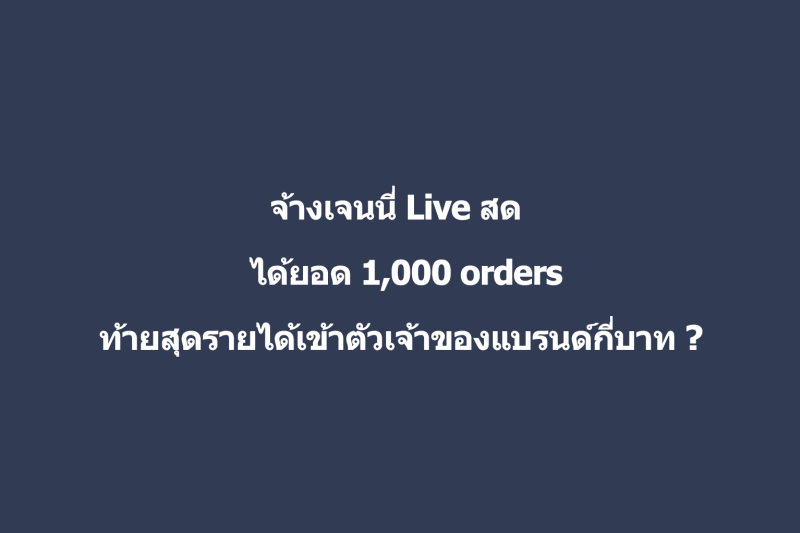
Right now we can’t escape the wave of “Jenny Gets It All If She’s Fresh” (“เจนนี่ ได้หมดถ้าสดชื่น”)
Even the manager is watching it all day and night.
From a micro‑influencer
Who shifted into a real‑time sales personality.
A person that brands contract
To create an immediate sales spike in 5–10 minutes.
But behind the strong sales
There’s a cost structure that’s more complex than what you see on screen.
Costs on the brand side (the hiring brand):
Jenny’s fee: 50,000 baht per one Live or one product basket — the base.
VAT 7% on Jenny’s fee, which the brand bears.
Platform fee on TikTok: 15% (automatically deducted by the system).
The rate of people who “click but don’t actually pay”: 20–30% (called fake conversions).
The rate of discounting product prices during the live: 20–40%.
Altogether, the system is similar to “buying one TV ad slot”
But the brand must bear all the sales risk themselves.
If we try to assume the variables we often see:
A small brand sells a product at 299 baht per piece.
Production + packaging + shipping cost per unit: 120 baht.
The brand sells 1,000 orders in one Live.
Let’s calculate how much actually reaches the brand owner.
Total revenue: 299,000 baht.
Deduct unpaid orders 25% (74,750) → 224,250 baht.
Deduct TikTok Fee 15% (33,637.5) → 190,612.5 baht.
Deduct cost 90,000 baht → 100,612.5 baht.
Deduct Jenny’s fee 50,000 baht → 50,612.5 baht.
Deduct VAT 7% on her fee, another 3,500 baht → 47,112.5 baht.
Which means the figure is about 47,112.5 baht.
That number still doesn’t include team wages for packing, returns shipping, or other costs.
The key breakpoint is:
If there are many orders but a high rate of non‑payment,
It may turn into a negative number.
Many people look at those figures and ask:
“If you sell and lose money, why sell at all?”
I borrow one sentence from พิมรี่ พาย:
“So why the hell do I have to sell things for profit?”
So: don’t look only at the loss side.
Because right now
Jenny is a tool
That creates a massive shockwave
In the Thai TikTok market.
I believe that many brand owners
Have already thought about these numbers.
From the consumer’s side
They might think the brand owner is selling the product.
But in truth, the brand owner is paying money
To buy something.
And what are they buying?
They are buying “Attention”, not “Profit”
In the TikTok Live era, think of Attention = Currency.
When Jenny appears on screen, views spike to hundreds of thousands in minutes.
A small brand barely known before
Becomes talked about overnight.
From an anonymous brand → becomes a searched name.
From a normal product → becomes “Jenny’s sold item”.
From 0 trust → becomes social proof.
Even if actual sales are negative
The brand gets exposure
That would cost hundreds of thousands in advertising otherwise.
So Jenny is not just a regular presenter
But a national‑level awareness accelerator.
They buy “Trust Borrowing”
TikTok’s customer group
“Don’t trust the brand, trust the seller.”
Jenny is a brand‑personality
With very high emotional connection with fans.
She’s both down‑to‑earth, sincere
And has the entertainer power for selling.
The brand owner doesn’t need Jenny
Just to sell 1,000 pieces
But to have Jenny endorse
So people believe that
Our product is truly sellable.
That people are really buying.
If Jenny sells this -> this product must be good.
If there are 1,000 orders in 5 minutes -> this product is hot.
That kind of trust
Cannot be bought by any other ad.
They buy “Momentum” to escalate the brand into the market.
Many brands know they lose money on the first Live
But expect that follow‑up sales will grow.
This strategy is called “Loss Leader Strategy”.
Losing money on one product
To open the door so other products in the store sell.
Example:
Sell a cream at 299 baht with loss
But after the Live customers return
Buy a serum / sunscreen / set
Or have repeat orders next round
At normal price.
For consumer behaviour on TikTok
If they’ve seen this product in a big Live → they’ll remember the brand next time.
They buy “Algorithm Advantage”
Don’t forget that TikTok
Is a platform that rewards “high engagement”.
Hiring Jenny = a big Boost
For the system to see your brand as “Hot Product”.
After the Live ends
Your brand’s video is recommended more.
The system learns “this product has demand”.
Your advertising CPM (cost per impression)
For your brand becomes cheaper.
You could say “losing money so that the system remembers our name”
Is a worthwhile deal
If you understand the algorithm.
They buy “Data” to learn real market behaviour.
Smart brands use Live like this
To “test the market”.
For example:
Which price point customers really buy.
What phrases stimulate sales.
The behaviour of customers who place but don’t pay
(Which group, which time?)
This data can adjust your entire year’s sales strategy
And is more worth the loss on one Live.
They buy “Positioning” in the battlefield where others don’t dare to go.
TikTok market now
Is like a battleground
Where only the ones willing to burn money survive.
A brand declaring
“We hired Jenny to sell for us”
Sends a signal that this brand
Has capital, has a game plan, and has guts.
It changes the customer’s impression
This isn’t just a regular SME brand any more.
It’s a mass‑market brand in a few minutes.
So
Brand owners know that
Hiring Jenny for a Live = a loss.
But they’re willing to “lose with a goal”
To buy things that normal advertising can’t.
Join the conversation at
https://www.facebook.com/Ex.MatchingProperty/posts/pfbid029N1nmnbC2YhLdSoYEumUavjmY7x48MrkcDK3RSdzfVvbFvpGGGV1izKWdEV4JLrql