





WeChat ID :


Login/Register

 Posted on 18 Nov 2025
 649313


Passive Income: the dream (and nightmare) of some people
A lie that is repeated so often
that many people believe it is true.
.
.
.
Written before the day when people want to get rich
but are not ready to take responsibility for the word “investment.”
Over nearly ten years,
I have met many people.
They all said the same thing:
they wanted income without having to work for it;
they wanted to “make their money work;”
they wanted to “sit still and watch money come in;”
they wanted to “rent out a property and travel around the world.”
Real-estate investment is one of the investment models people imagine that way.
Real estate is therefore promoted as a magic door:
buy a unit, rent it out, wait for the transfer,
and spend the rest of your time in the Maldives.
Everything sounds good and comes with luxury hashtags.
But no one tells you how bitter the reality can be.
I do not have a problem with that dream.
I have a problem with people believing
that Passive Income is easy,
as if real-estate coaches had gently persuaded them to believe it.
There is nothing wrong with wanting Passive Income.
But if you begin with desire
without planning, calculating or taking responsibility,
it will not be income.
It will become an unexpected expense.
I have seen many people
buy a condominium to rent out
without checking the real rental market,
without knowing what kind of tenants live in the area,
and without knowing what must be kept in reserve each month.
They see only a sales listing,
believe a good-looking salesperson,
and decide to put down the money.
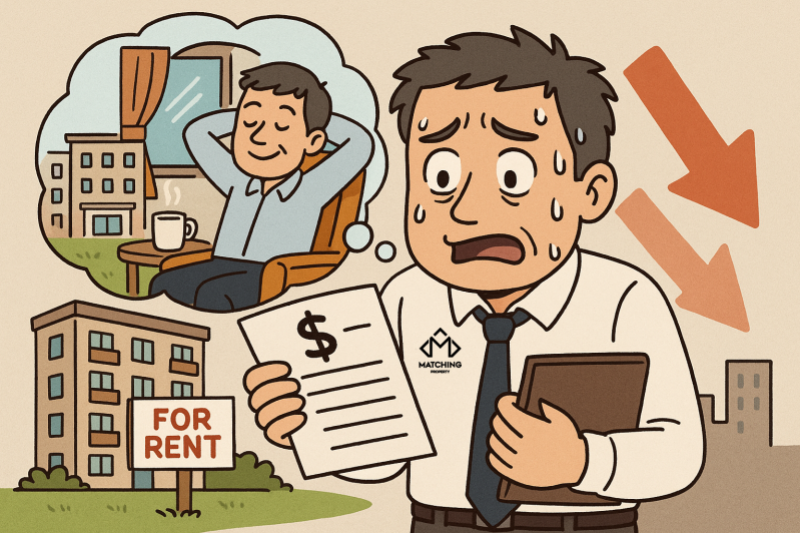
The salesperson says it can rent for 15,000 baht per month,
but in reality it rents for 12,000 baht.
The buyer forgets that the bank payment is 17,000 baht per month,
and there is also a hidden common-area fee of 1,000 baht per month.
That is before the agent’s commission,
the day the water heater breaks, a tap leaks or an electrical socket burns,
or the time a tenant falls two months behind on rent
and leaves the unit in a condition nothing like it was before.
That is another side you did not think about.
Ten years ago, I nearly made a mistake.
I almost believed a condominium salesperson who said
the bank payment would be 24,000 baht per month
and the unit could rent for 22,000 baht per month,
so I would need to add another 2,000 baht every month.
It was presented as a form of DCA.
Whenever I received a bonus or a lump sum,
I would keep making extra payments.
After ten years,
I would own a condominium in the city centre.
If I had believed that salesperson,
what would my life have been like?
Before the condominium becomes an asset,
for ten years it is a liability
that ties you down.
During those ten years,
your life must have no problems at all:
you must not get sick, die, lose your job,
or have your company or business run into trouble.
Is real life really that perfectly lavender?
I have never seen anyone succeed in real-estate investment
without thinking about a proper plan and good management.
People who say they have Passive Income
were all intensely active before that.
They counted occupancy rates
by watching how many rooms had lights on at night.
They went to the police station
to resolve payment issues with tenants who defaulted.
They inspected units in person
and even re-grouted bathroom floors themselves.
Or they received a lawyer’s notice
because they forgot to pay a bank instalment.
Some people say they hire an agent to manage everything,
which is a good thing.
But you must understand
that you still have to “manage the agent.”
Nothing that you do not control
will move forward by itself.
Real estate does not rent itself out.
It has no automatic function.
There is no AI that cleans the room.
There is no system that prevents tenant misconduct.
There is no software that automatically checks the condition of a unit.
You may say you only need to invest
and wait for the return.
I want you to sit quietly
and ask yourself again:
are you expecting a “return,”
or is it actually “retaliating” against you?
You wait for Passive Income,
but your account contains only payments.
You dream of renting the unit out,
but you end up chasing the tenant for rent every month.
You want to escape your day job,
but you receive a new job instead:
Owner/Landlord,
one that is more exhausting than the old one.
Because Passive Income
does not mean buying once and getting paid.
It means planning
and building a system that can truly make money work.
Before you ask for Passive Income,
have you ever asked yourself:
✅ Do you have an emergency reserve? How much? Six to twelve months?
✅ How many rental plans do you have?
✅ If the tenant disappears for six months, will you survive?
✅ How much information do you have before deciding to buy a unit?
✅ Do you know that some unit positions are harder to resell than ordinary ones?
✅ Do you know which layout plans answer your customers’ needs?
Or are you buying
because a friend saw another friend buy?
Or are you buying because the sales manager
gave you a special price?
Do not answer me.
Just answer yourself.
I did not write this article
to tell you that you are wrong.
I wrote it to make you think—
to think before everything passes the point of no return.
Real estate is not difficult… but it is not easy.
Having income without having to work… is not easy.
Not having to work is not something you receive
without exchanging something for it.
Everything requires an exchange.
Some people pay with knowledge.
Some pay with planning.
But the people who get hurt
are those who pay with hope.
And you will be hurt even more
if you keep using a dream
as the measure of whether an investment is worthwhile.
There is nothing wrong with Passive Income.
But it becomes wrong immediately
when you use it as an excuse
not to work,
not to take responsibility,
not to calculate,
or to deceive yourself that “it will work”
when you do not even know
where you are going.
This is not a warning.
This is a “scar.”
It is the painful trace
left by people who walked this path before you.
You can believe it or try it yourself—that is your choice.
I am only doing my job:
putting this here
so that one day, if you come back to read it,
you will know
that someone once said it,
but we chose not to listen.
Do not rush.
But be mindful before you walk.
And remember…
Passive Income will never happen
if you have not first dared to control your own Active Life.
What is Active Control?
It is “continuous control of the situation.”
Not only when you buy an asset,
but also while you hold it.
When it makes a profit.
When it does not make a profit.
When everything is calm.
And when everything is extremely chaotic,
like the recent earthquake.
Active Control is not merely going to look at the property.
It is understanding every variable
that can affect your income.
It means knowing
who is renting this unit,
who is on the contract,
and when the contract will expire.
Knowing every expense,
what has already been paid this month,
and what must be prepared for next month.
Knowing what the risks are
and preparing a response plan in advance,
rather than starting to think
only when the problem begins to erupt.
Knowing what problem the tenant has
and reaching them appropriately.
Knowing the current condition of the property,
rather than discovering it only when the tenant returns the unit.
Knowing whether the rental market is rising or falling,
rather than merely hoping that “it will get better by itself.”
Active Control
means not leaving everything to luck.
It means controlling every variable
that can be controlled.
Because the less you can control,
the more risk will control you.
So what does Active Control in real estate require?
It starts before you buy:
✅ Have you checked the location?
Not only “is it near a train station,”
but which train line,
whether there is a lot of pedestrian traffic,
and who your tenants are.
Are they working people, travellers or families?
✅ Have you compared prices?
The purchase price of the condominium
with the actual rental prices of other units in the market.
Will you make an immediate profit or lose for sure?
✅ Have you checked hidden costs?
Common fees, renovation costs, transfer fees and juristic-person fees,
which continue throughout the period you own the property.
✅ Do you have a tenant-management system?
Document collection, rent follow-up, reminders and complaint handling?
✅ Do you have a maintenance schedule?
Because property deteriorates over time.
If you do not repair it today,
the repair may be much heavier three months from now.
✅ Do you have an emergency reserve?
If a pipe bursts and the floor has to be broken up
while you have no repair money,
the damage will not wait until you have saved enough.
So, do you want Passive Income?
You must be active enough in your role as a property owner.
Money that requires no effort
will never come
if you have not first worked to control it.
People who think “once I buy it, everything will be fine”
are waiting for the day an expense bill hits them in the face.
People who think “I will hire an agent to manage it and do nothing”
are ignoring their own responsibility.
But the person who “controls everything that can be controlled”
is the person who builds a real system
and truly survives every storm.
Passive Income was never meant for people who sit and wait.
It is for people who “control their own lives”
at a high enough level
to put the work down without leaving problems behind.
If an asset is not yet ready to support you,
it becomes a burden that you must support instead.
.
Join the conversation at
https://www.facebook.com/Ex.MatchingProperty/posts/pfbid023JuLBjqZe443mPWWLH4XPdJSwosY8YQtb8jiLCi3vWKodciQJwxNFUkza1oLjUiCl