



WeChat ID :


Login/Register

 Posted on 8 Jul 2025
 68333
68333


Today I came across an interesting topic —
If you rent out houses or condos,
you might not face this often.
.
But if you’re in commercial rental — shopfronts, kiosks, restaurants —
you’ll encounter this all the time.
So often, in fact, that many people start getting confused
about what kind of “right to use” they actually have.
Let’s break it down clearly.
.
Let’s define each first.
.
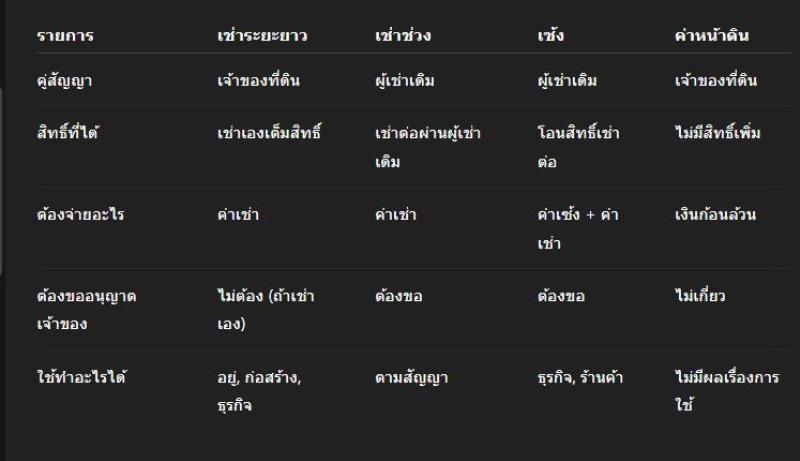
Long-term lease means:
✅ A contract between landlord (A) and tenant (B)
✅ Fixed duration — from 3 to 30 years
✅ Tenant pays rent monthly or annually
✅ Right of use ends when contract expires
✅ Common in property leases — houses, land, office buildings
.
Lease transfer (Sang) means:
✅ Transferring the right to lease from old tenant to new tenant (A → B → C)
✅ Usually involves a lump-sum transfer fee (called “Sang price”)
✅ The new tenant inherits the right to use the property until the lease expires
✅ Very common in businesses — restaurants, market stalls, or mall shops
✅ Often includes furniture, equipment, and shop fixtures
.
.
Long-term lease = tenant deals directly with owner, term ≥ 3 years
.
Lease transfer (Sang) = tenant pays the previous tenant a lump sum
that may include:
✅ value of equipment
✅ deposit
✅ contract/transfer fees
✅ other admin costs
The outgoing tenant bundles all that into one “Sang fee.”
.
.
Now many people will ask —
“So… is the Sang fee the same as the Key Money?”
Answer: ❌ No, it’s not.
.
They’re both upfront payments,
but for totally different purposes.
.
💰 A lump sum paid to the landlord, not the old tenant.
💰 It’s a “privilege fee” for obtaining the right to rent a good location.
💰 Usually collected in addition to regular rent.
💰 Sometimes justified as compensation for lost opportunity —
since the owner can’t lease the space to anyone else during the term.
.
Key money is common in long-term leases,
rare in short-term ones (but not unheard of).
.
What you actually get in return is simply
the right to lease for the agreed period — nothing more.
Mostly used for leasing land for development or commercial use.
.
.
✅ Direct contract with the property owner
✅ Duration 3–30 years
✅ Rent paid monthly or yearly
✅ Used for living, business, or development
✅ May include key money if owner requires
.
✅ Tenant (B) rents the property out to someone else (C)
✅ Must have landlord’s consent
✅ Subtenant (C) doesn’t deal directly with owner
✅ Without consent, it can breach the lease
.
✅ Old tenant transfers all rights to new tenant
✅ Usually includes Sang fee (lump sum)
✅ Rights continue until the original lease expires
✅ Often includes existing fixtures, furniture, business assets
✅ Must check if the original contract allows transfer
.
✅ Lump sum paid to the landlord
✅ A “location fee” or “entry privilege”
✅ Found in both short and long-term commercial leases
✅ Gives no ownership — just access and goodwill
.
It may sound complicated on paper,
but once you’ve worked in property for a while,
you’ll know exactly which term applies.
So be careful with wording —
because each term means something completely different in law.
.
Join the discussion at
https://www.facebook.com/Ex.MatchingProperty/posts/pfbid0hgXn4rSF7r9NSZ6PruhLBcDG3XFwAnxurQEwkLZV7xV1HWYXXrekDbLbQMMYy59cl